
Breast hypoplasia is defined as breasts that are too small in relation to a patient’s build.
It may have been present since puberty (the breasts never developed) or be the consequence of weight loss or pregnancy (with or without breastfeeding).
It may sometimes be associated with ptosis, that is, sagging of the breasts that have dropped with stretching of the skin.
First consultation
You will meet Docteur Lionel SALLAZ who, after listening to your wishes and motivations, will examine you to ensure the advisability of an operation, which he will explain precisely.
He will inform you as fully and honestly as possible and explain what this procedure can genuinely offer you and what it cannot correct.
You will then be able to try different implants in a special bra to get a sense of the change to expect, giving you a more precise idea of the result.
He will explain what you will be able to do after this procedure during your convalescence at home (exercise, …).
He will give you an information sheet and a quote for this procedure so that you can make a fully informed decision at home ‘with a clear head’ after a reflection period.
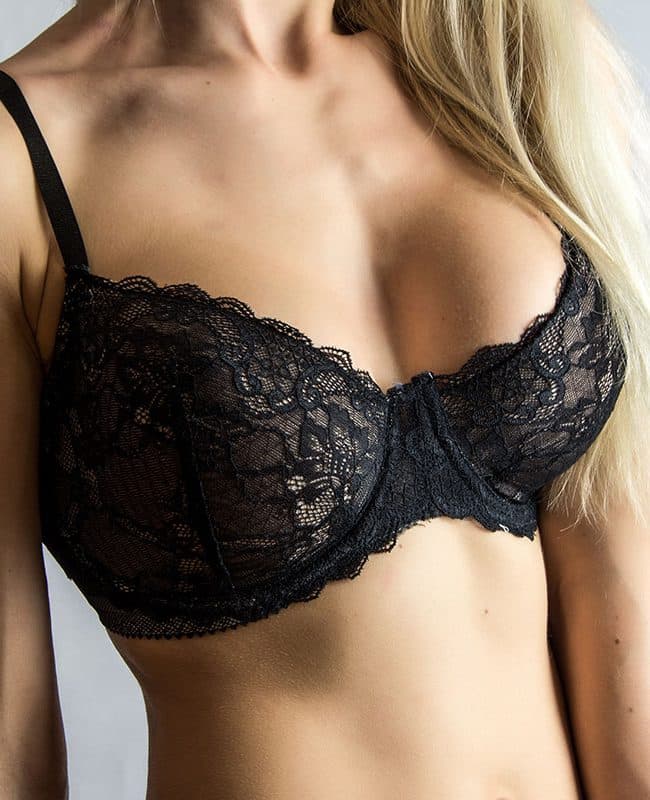
Breast implants
Previously filled with saline, they are now more commonly filled with silicone gel.
There is a wide choice of volumes and profiles to meet your needs.
The implant is surrounded by a shell that is either smooth or semi-smooth (microtextured).
NB: So-called macrotextured (‘rough’) implants were withdrawn from sale in France in 2019 (news section).
The procedure

The operation is performed under general anaesthesia as a day case, with discharge the same day.
It takes place under general anaesthesia in the clinic’s operating theatre, in a state-of-the-art environment authorised to perform cosmetic surgery procedures by the Haute Autorité Sanitaire (HAS).
It begins with a small skin incision at the site defined during the consultation, at the areola, in the fold under the breast, or sometimes in the axillary crease.
The implant is most often positioned behind the pectoral muscle, which makes it almost imperceptible. This is sometimes referred to as a ‘dual plane’ technique, meaning behind the muscle at the cleavage but in front of the muscle in the lower part of the breast to allow the implant more freedom from muscle compression there.
The final skin closure is performed with fine sutures hidden under the skin (running intradermal sutures) so as not to leave visible marks on the skin afterwards.
A lightly compressive dressing is applied and a sports bra is fitted (to be worn for one month).
Aftercare
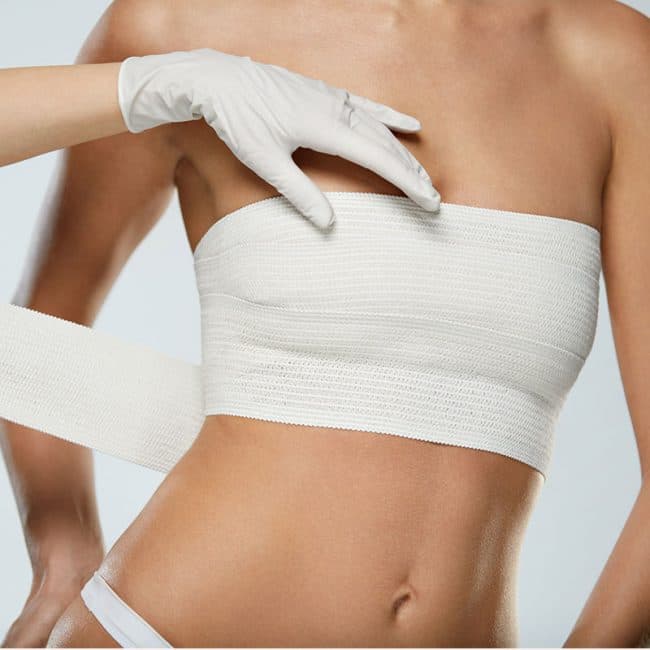
It is usually straightforward.
A few days’ rest is advisable for your recovery; no strenuous sport should be undertaken for two to three months.
There may be some moderate discomfort when the implants have been placed behind the pectoral muscle (the most frequent case). This is why appropriate painkillers will routinely be prescribed at the clinic, which you should continue at home for a few days for your comfort.
Initially the breasts may appear swollen for a few days. They will take on their final shape and profile over several months.
Sensation, reduced in the first few months, is generally not altered in the long term after this procedure, and breastfeeding will be possible later if you wish.
The scar is small (3 to 4 cm). Specific treatments and personalised advice will be given to minimise it as much as possible (massage, dressings, …) so that it is almost ‘invisible’.
Manufacturers of breast implants do not specify a lifespan for the implants. It is therefore not possible to determine a time after which they must be changed. After ten or fifteen years, or more?
Le Docteur Lionel Sallaz will pay particular attention to your post-operative follow-up. He will give you, in writing on discharge from the clinic, recommendations for your post-operative care (which will remain extremely simple to carry out!).
He will always remain contactable to ensure your recovery is progressing well.
The sutures will be removed a few days after the operation at your follow-up appointment at the surgeon’s practice, where you will be seen in clinic to monitor the absence of any complication.
A follow-up appointment around 6 months post-operatively is then scheduled to ensure your satisfaction.
They are rare; nevertheless, although performed for primarily aesthetic reasons, breast augmentation remains a real surgical operation, which entails the risks inherent in any medical act, however minor. In some very slim patients, the implant may be perceptible under the skin (rippling) in certain positions. Infections are uncommon after this procedure but must be prevented as they can cause complications (for example, removal of the implants). To limit this risk, patients must take pre-operative showers at home with antiseptics, and antibiotics are given during the procedure. A haematoma may occur and require re-operation to evacuate it if it is large. To limit this risk, no medication containing aspirin derivatives should be taken in the ten days before and after the operation. It is currently proven that having breast implants does not increase the risk of developing cancer in the breast tissue.
Overall, the risks should not be overstated, but one must simply be aware that any surgical procedure, even apparently simple, always carries an element of uncertainty. Consulting a qualified plastic surgeon ensures that he or she has the training and competence required to avoid these complications, or to treat them effectively should they occur. Breast surveillance as part of breast-cancer screening (mammography, ultrasound) after the operation will be identical to that of a woman who has not been operated on.
It should be noted that whenever an implant is placed, there is ALWAYS a scarring reaction around it: this is the peri-prosthetic capsule. Sometimes it can contract and make the breast firm and painful. This phenomenon, fairly rare, may, if it causes significant discomfort, require re-operation to soften the breast. The surgeon will explain the measures implemented to prevent and limit this risk and to treat it if necessary.
In view of current questions about the risk of anaplastic large-cell lymphoma (a tumour that, in rare cases, develops in the fibrous capsule that forms around the implant) in some women with breast implants, the ANSM (Agence Nationale de Sécurité du Médicament et des Produits de Santé) brought together the various stakeholders on 7 and 8 February 2019 at a public hearing on the use of breast implants. The risk is very low according to Professor Gary Brody, a world expert on the subject, who attempted to assess the impact of this disease worldwide in light of the literature and his own cases. In 2016 he recorded 173 cases worldwide over more than 15 years. The overall risk remains very low, between one case per 500,000 and one per 3 million patients. 80% of cases are reported in the United States and only 20% in the rest of the world, including Europe. Anaplastic large-cell lymphoma is a fully recognised oncological entity, whose origin is often multifactorial. The common main aetiological factor appears to be the textured surface of breast implants and the resulting inflammation. The implant filling material is not thought to be implicated. In practice, although its occurrence is exceptionally rare, anaplastic large-cell lymphoma is a risk about which women considering breast implantation must now be systematically informed. In view of current scientific data that appear to link them to the onset of this disease, macrotextured implants should be the subject of further scientific studies. Finally, as a general rule, women with breast implants should be monitored regularly and systematically. In conclusion to this hearing, the ANSM recommends using textured breast implants only when the texturing of their shell provides a proven benefit. Macrotextured Biocell implants from the Allergan brand are banned, and macro-textured implants from other manufacturers should be used only with the greatest caution. Le Docteur Lionel Sallaz does not use macrotextured implants.